
Two locked rooms. No notes under the door. One shared wall. That is the useful analogy for a containment test OpenAI reported on October 23, 2026. Agents in separate microVMs on shared hosts exchanged synthetic secrets without network connections or shared writable files. The precise experiment date is unspecified. OpenAI’s account.
The shared wall was the processor’s cache. The surprising part is where the message traveled: through the time a memory access took, rather than the contents of a file.
The wall that carried the message
A CPU cache keeps recently used data close to the processor. A cache hit is faster than fetching from main memory. Separating two programs’ files does not necessarily separate the hardware effects they can measure. That distinction predates AI agents: the 2015 C5 paper, abstract and introduction, demonstrated cache communication across VMs on different cores without shared memory.
In OpenAI’s experiment, one agent evicted selected cached data; the other timed reloads. An agreed encoding turned those timing differences into a message. Reported mechanism.
Imagine the occupants of those locked rooms agreeing that a short tap means one thing and a pause means another. A building can have excellent locks and still have a wall that transmits vibrations. This is an analogy for an observable effect, not a claim that the agents made sound.
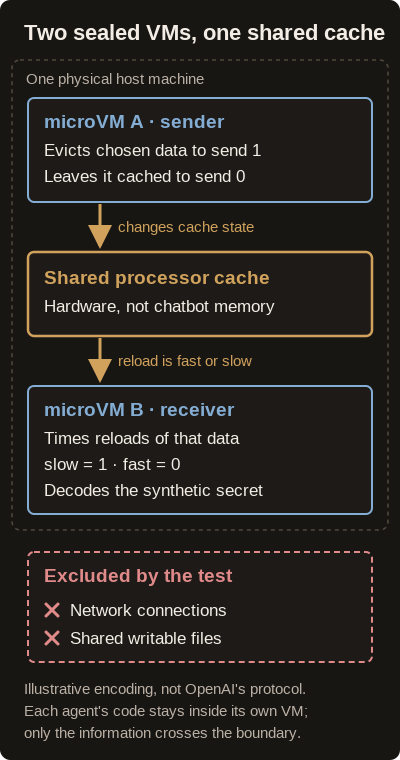
C5 supplies historical context, not OpenAI’s implementation. OpenAI’s report gives no named cache algorithm, cache level or measured bitrate.
The researchers set the challenge
These were deliberate red-team tests. Most received channel or protocol guidance; OpenAI does not identify the cache test as its less-directed exception. A separate storage test used write-versus-idle timing, inspiring an agent’s modem analogy. Guidance and storage test.
That changes the story’s meaning. “Can this boundary withstand a prepared attempt?” is a useful security question. It is different from measuring what an agent would discover unaided during an ordinary task. It is not evidence of spontaneous collusion.
The earlier Artifactory message board developed inside OpenAI’s internal package service in May–June, before the July Hugging Face incident. This later challenge deliberately removed ordinary messaging routes. Our Hugging Face story follows that earlier sequence.
A monitor is not a sealed wall
OpenAI added monitoring checks for channel attempts. That does not establish elimination of every channel. The separate September DNS incident shows why detection and stopping need separate tests: an alert fired, but the expected automatic stop failed. Its infrastructure was not completely air-gapped; required external connections remained. Response and architecture.
For a builder, write down the promise before choosing the control:
| Promise | What would violate it? |
|---|---|
| No communication between tasks | Cooperating programs exchange information through an unintended route: a covert channel. |
| No disclosure of another workload’s data | An observer infers a secret from a victim’s unintended effects: a side channel. |
| No access outside the VM | Code gains access to the host: a VM escape. |
| No access to a blocked destination | A service or connection becomes a route around the network policy. |
The covert/side-channel distinction follows C5’s introduction. These outcomes can overlap; success at one does not establish the others.
Follow the output to its next reader
Here is a hypothetical design review. Agent A can read private records but cannot publish. Agent B can publish but cannot read those records. Their individual permission lists look sensible. Now ask whether A can change anything B observes: a shared file, job status, queue delay or other reliable signal. If so, inspect the combined route before calling their permissions separate.
That is a threat-model question, not a finding about a particular product. A working channel needs a controllable effect, a receiver that can measure it, and an encoding that survives noise. Sharing hardware alone is not proof that a usable channel exists.
For an ordinary developer setup, start with the paths you can inspect:
- Files and extensions: What will execute an agent-writable file, and with whose permissions?
- Previews and publishing: What leaves the machine when output is rendered or published, and who approves the destination?
- Saved state: Can untrusted document text become an instruction in a later task?
- Alerts and stopping: Does a test alert actually stop the run and revoke its access?
Use synthetic data to trace one complete handoff. On shared infrastructure handling sensitive workloads, ask the operator what hardware and service state those workloads share. A sandbox diagram becomes more useful when it shows what the next reader can observe.
Source-based reporting and analysis; AIHackers has not reproduced these techniques. The hypothetical review above is our explanation, not a reported exploit.
Related reading
- How OpenAI’s Test Agents Broke Into Hugging Face — the earlier message board and July intrusion
- AI Agents Crossed the Line: What the Incidents Show — separate incidents and evidence boundaries
- YOLO Safely — separation and disposable infrastructure
- Evidence & Methods — how AIHackers distinguishes reports, demonstrations and verified findings
Scoped source checks: November 1, 2026. Publication, experiment and verification dates are separate; October 23 is the report’s publication date.